Home Wellbeing of Women Logo

Women’s health highlight: Improving the effects of chemotherapy for ovarian cancer?

High grade serous ovarian cancer is the most common type of ovarian cancer and stubbornly resistant to treatment. Dr Samar Elorbany’s research, funded by two grants from Wellbeing of Women, is opening up new treatment options for women to live longer, cancer-free lives

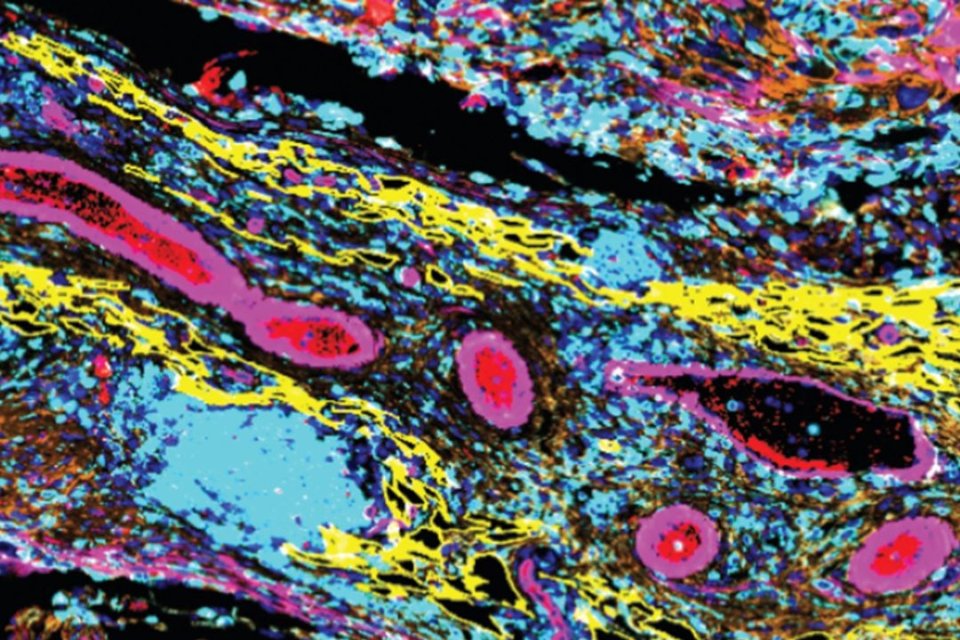
microscopic image of ovarian cancer cells, blood vessels, immune cells and structural surrounding tissues

The overview

Ovarian cancer is notoriously difficult to treat. For several decades chemotherapy has been the main treatment, which works well for many women – at first. But 75% of patients with the most common type of ovarian cancer (High Grade Serous Ovarian Cancer) will find that their cancer comes back within two years, and more resistant to chemotherapy.

Dr Samar Elorbany, funded by Wellbeing of Women, has been searching for ways to improve the cancer-fighting effects of chemotherapy for women with HGSOC.

Treatments for ovarian cancer

Ovarian cancer is currently usually treated with a combination of drugs (chemotherapy) and surgery. Chemotherapy is used before surgery to stop the cancer from growing, and then surgery removes as much of the cancer as possible. But chemotherapy does not have a straightforwardly helpful effect on the body. It can harm, as well as help. There are some drugs that are given in addition to chemotherapy that can make chemotherapy more effective and reduce the worst side effects, but these are not always successful in treating patients with HGSOC. For these patients, new combinations and fresh approaches are desperately needed.

Chemo, cancer and the body’s fighting force – the immune system

When we think of our bodies fighting cancer, we think of our bodies’ natural defences – the immune system - destroying cancer cells from within. But part of the reason cancer can be so difficult to treat is that cancer can ‘trick’ our body into ignoring it and letting it grow instead.

Tackling the tumour ecosystem, or TME

In some cases, cancer can even influence the behaviour of our immune system to help cancer grow. During her Wellbeing of Women-funded PhD at the Barts Cancer Institute, Samar investigated the area surrounding ovarian cancer tumours – called the tumour microenvironment, or TME. Tumours are made up of much more than just individual tumour cells – rather they form a system of growth and survival, including support cells, immune cells, blood supply, and other food sources. Collectively, this is known as the TME and is an increasing area of interest for researchers.

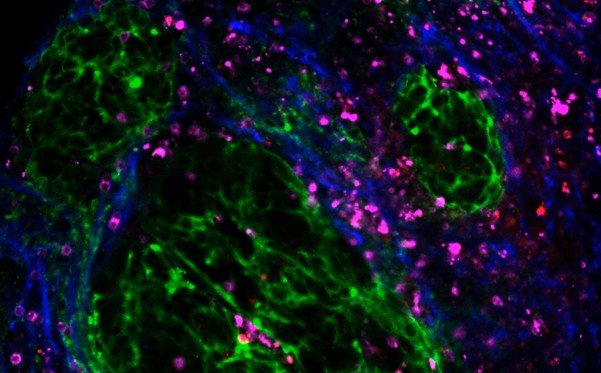
microscope image of a biopsy of high-grade serous ovarian cancer. Green cells are malignant cells clustered together, the extracellular matrix is blue and the immune cells are pink and red
Image credit: Dr Florian Laforets, Barts Cancer Institute, Balkwill lab

Samar found that chemotherapy actually changed the behaviour of some of our immune cells – specifically macrophages and T Cells - into helping ovarian cancer tumours grow. By understanding the effects of chemotherapy on the TME at the cellular level, she was able to identify potential ways that this environment (the TME) can be modified – or targeted by drugs - to help women with HGSOC live longer and prevent relapse.

Innovative combinations

Her follow-up grant from Wellbeing of Women enabled Samar to test exactly which drugs might improve the cancer-fighting effects of chemo. Through the expertise gained in her PhD fellowship (and an MSc in Bioinformatics alongside it), Samar was able to experiment with different combinations of chemotherapy and drugs that targeted elements of the TME she had already identified.

In these experiments, Samar found a breakthrough - certain combinations of drugs have the potential to make chemotherapy more effective for women with HGSOC. And by using the skills she gained in dealing with large numbers she has been able to come up with many more potential combinations. Her breakthroughs mean that it is now possible to start testing these combinations in humans, which is a huge step in the journey towards improving the treatments available to women. The results of her incredible work have since been published in a leading scientific journal.

My vision for the future of ovarian cancer treatment is one where we know which combinations of treatment work best in different scenarios and are able to prolong survival and prevent relapse Dr Samar Elorbany Clinical Lecturer and Group Leader, Balkwill Lab, Bart's Cancer Institute CRUK, Queen Mary University of London

About Samar

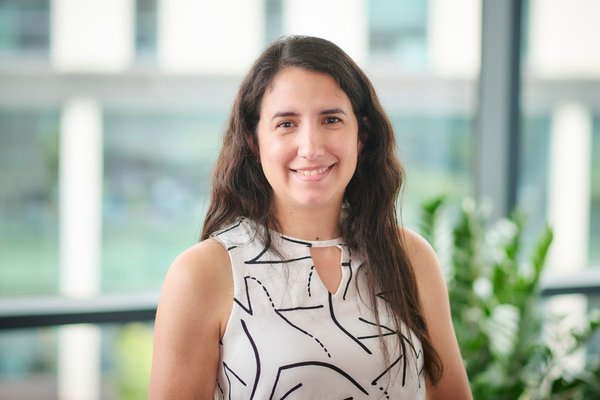
Samar is a surgeon with first-hand experience of treating the women that her research will impact. She said, ‘My vision for the future of ovarian cancer treatment is one where we know which combinations of treatment work best in different scenarios and are able to prolong survival and prevent relapse’.

Samar completed her clinical training in Obstetrics and Gynaecology in Egypt before moving to the UK in 2013, where she undertook a Clinical Research Fellowship at the University of Oxford. She joined the Barts Cancer Institute, Queen Mary University of London, in 2019 and went on to undertake her Wellbeing of Women-funded PhD with Professor Fran Balkwill. During this time, she also completed her MSc in Bioinformatics. She was awarded a Clinical Lectureship at the Barts Institute in 2023.