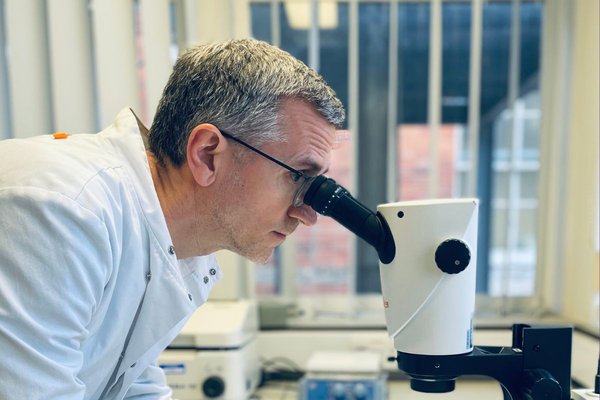
Rare, but deadly: tackling placental cancer
Ovarian cancer is cancer of the ovaries or fallopian tubes. Around 7,500 women get ovarian cancer in the UK each year.
Ovarian cancer is cancer of the ovaries and the fallopian tubes.
The fallopian tubes attach the womb to the ovaries. They collect the egg when it is released from the ovary and transport the egg to the womb.
Doctors now think that many ovarian cancers may start in the end of fallopian tubes where they attach to the ovary. Ovarian cancer happens when cells in the ovary or fallopian tube become abnormal. These cells can grow and divide uncontrollably.
These cells can fall off from the surface of the ovary or the lining of the fallopian tube and spread throughout the abdominal (tummy) cavity. The cells then attach to the lining of the abdominal cavity (called the peritoneum) or onto the outside of other organs, like the bowel. They can grow into further tumour deposits called metastases. In ovarian cancer, this spread can happen very early, even when there isn’t a visible mass on the ovary or tube. Eventually the abnormal cells can spread to other organs outside of the abdominal cavity.
Around 7,500 women get ovarian cancer in the UK each year. It is most common in women over 50, but younger women can still get it. Some rarer types of ovarian cancer are more common in younger women. Ovarian cancer can affect anyone who has fallopian tubes or ovaries, so some trans men and some non-binary people can also be affected.
We don’t yet know the cause of ovarian cancer. The biggest risk factor for ovarian cancer is getting older and the risk rises steeply from the age of 45. It is most common in women and people who have been through the menopause.
You might also be more at risk of ovarian cancer if a close blood relative, like your mum or sister, has had ovarian cancer, or if you have a family history of breast cancer. This is because some ovarian cancers are caused by an inherited faulty gene – BRCA1 or BRCA2. If you are worried about this, speak to your GP as they can assess your risk and decide whether you would benefit from a referral to a specialist genetics testing service. Lynch Syndrome affects 1 in 278 people and causes some families to have high rates of some types of cancer, including bowel, womb, prostate, ovarian and stomach cancer.
Around 5-15% of ovarian cancers are caused by a genetic mutation. If you are found to have an inherited risk of ovarian cancer, you can be offered surgery to remove your tubes and ovaries to reduce your risk significantly. Surgery is offered if you do not hope to get pregnant in the future.
Other factors that can affect your risk of ovarian cancer include:
Some things can reduce your risk of ovarian cancer:
It's estimated that 35% of cases of ovarian cancer are preventable.
Symptoms of ovarian cancer are not always obvious, and some people may not notice them, or think they are symptoms of other conditions.
If you do notice symptoms of ovarian cancer, they’re most likely to include:
Other symptoms include:
If you have any of these symptoms, you should speak with your GP. These symptoms can be often caused by other benign conditions, such as irritable bowel syndrome (IBS), but it’s important to get checked out. This is especially important if you’re over the age of 45 or have been through the menopause.
It’s a good idea to keep a diary of your symptoms and take this when you visit your GP. Useful things to record include date and time of symptoms, if anything makes symptoms worse, when they started and how often they occur. You may want someone to go with you to your appointment for support.
The earlier ovarian cancer is diagnosed, the easier it is to treat. Unfortunately, we don’t yet have effective ways to screen for ovarian cancer.
A GP will first ask you questions about your symptoms. They may investigate further and:
Depending on the outcomes of their investigations, doctors may arrange an ultrasound scan of your tummy and pelvis. This may lead to a referral to a gynaecology cancer specialist. Sometimes your doctor will refer you straight to the specialist before the test results are back. The specialists may arrange for further tests like blood tests, scans or biopsy before they see you.
The cancer may be staged and graded to help inform the treatment plan. This describes the size, whether it has spread and the changes in the cells. Find out more about staging ovarian cancer on the Macmillan website.
If they don’t refer you for investigation and you’re still concerned, it’s okay to ask them why and for more information.
If the tests are initially reassuring, but your symptoms persist or worsen over the next few weeks or months, go back to visit your GP again.
The treatments you receive will depend on the stage and type of ovarian cancer you have.
In some cases, when it is caught early, ovarian cancer can be completely treated. For others the treatment may help to control the disease for months or years before it comes back. All treatments are likely to trigger menopause however, if you have not yet been through the menopause.
Treatments is often a combination of:
If you are diagnosed with ovarian cancer, your doctor will discuss treatment options with you. You will also be able to ask them any questions that you might have. You will also be assigned a cancer nurse specialist who will be your contact person and is there to support you through your treatment.
It is a good idea to discuss what your options are, and the benefits and risks of each, so that you can reach a decision that is best for you.
Many people with ovarian cancer will need to have their ovaries, fallopian tubes and the uterus (womb) removed during surgery. This means you won't be able to become pregnant naturally. There may be other ways to have children such as IVF, surrogacy or adoption.
Sometimes it’s possible to have treatment to remove just one ovary, which means you may still be able to get pregnant in the future.
Ask your doctors and nurses for information about your fertility options.
Worries about a possible diagnosis or living with cancer can be very challenging. Sometimes it can help to speak to people who understand and have experience of an ovarian cancer diagnosis.
You can read Sbba’s story and Amy’s story of ovarian cancer.
You can read more about ovarian cancer and the treatments available on the NHS website.
If you are worried about ovarian cancer or have been recently diagnosed, you can get support. These organisations offer information, help and advice:
Watch again: Preventing gynae cancers webinar
In our latest webinar, we asked, can we prevent gynaecological cancer? We discussed the symptoms, how to reduce your risk, screenings that are available, and how to make sure screenings are accessible to all.You can also watch our webinars on gynaecological cancers, which feature experts and people with lived experience:
Let’s talk gynaecological (gynae) cancers – with Dr Neil Ryan and Sbba Siddique
Let's talk gynaecological cancers webinar – with Dr Sarah Kitson
As a women’s health charity, we fund research to save and change the lives of women, girls and babies.
Our research has identified that a simple blood test, which can be given by GPs, could help diagnose ovarian cancer faster and more accurately.
We are currently funding research to understand:

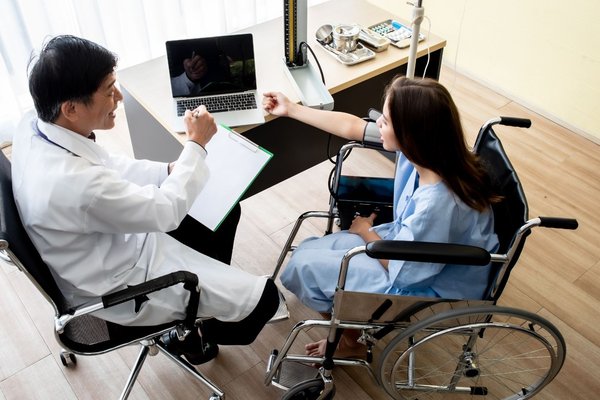
Finding the right information and support about gynaecological cancers can feel difficult, especially if you face barriers because of language, disability or a lack of tailored resources.

Cervical cancer develops in the cervix. This is the opening of the womb (uterus) into the vagina. There are over 3,200 cases diagnosed every year in the UK.

Most womb cancer starts in the lining of the uterus (womb). Around 9,700 women are diagnosed with womb cancer each year in the UK.